Between Strangers and Myself
I took this photograph almost instinctively.
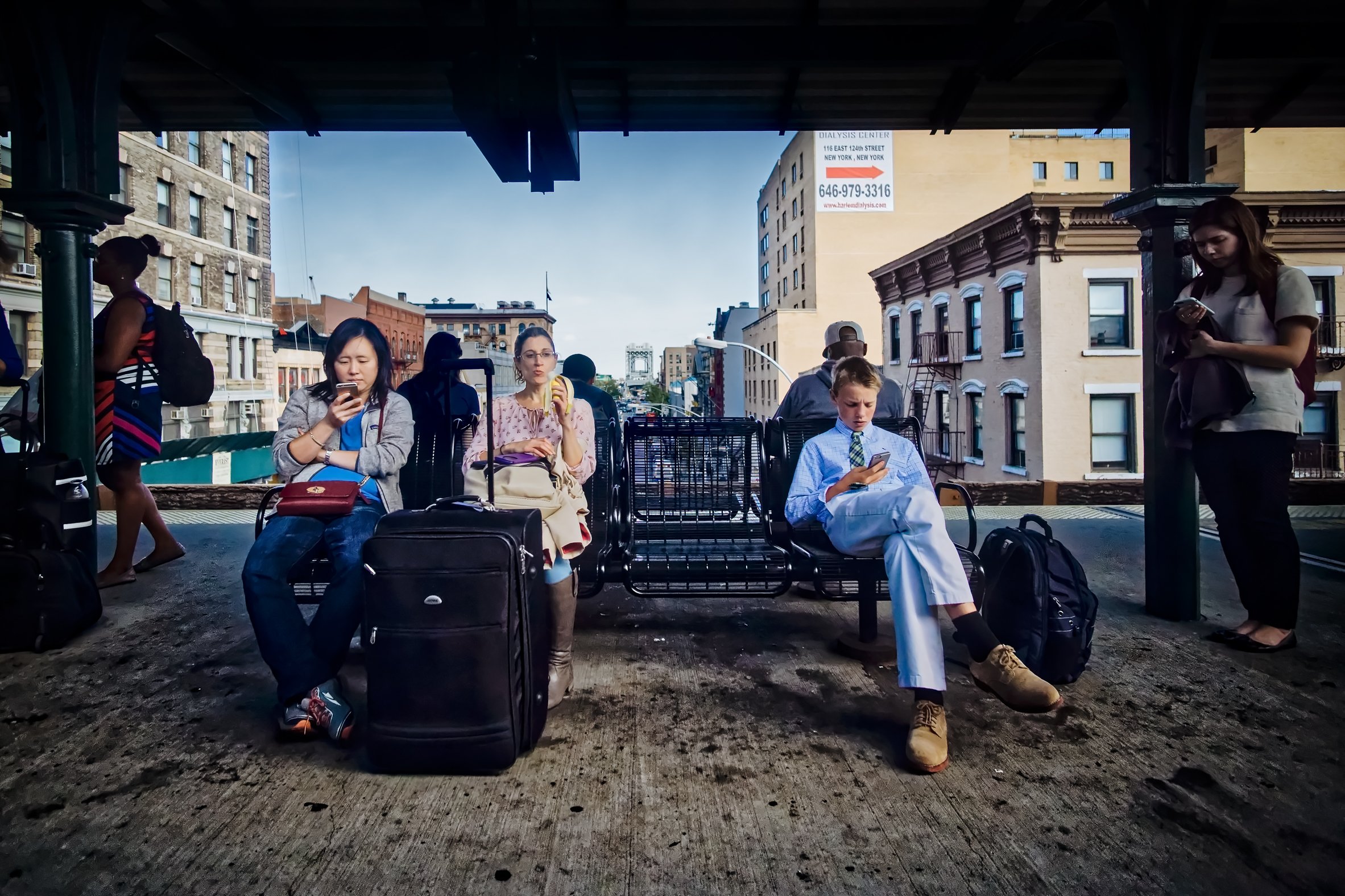
I was sitting on an express train heading north on the Hudson Line, on my way back to Westchester, which I still think of as home. We passed the station on 125th Street, and for an instant I saw this arrangement of people beneath the elevated tracks: strangers sitting, standing, waiting, absorbed in their phones, fall sun in this gentrified section of the city. I lifted the camera and made the photograph. That was it.
I didn’t stop to study them. I didn’t know their stories. I wasn’t looking for a particular gesture or waiting for something to happen. The scene appeared, and almost as quickly, it was gone.
Yet I have returned to the photograph many times.
Perhaps because I have been fascinated since I was young by a problem that seems both obvious and impossible to resolve: we live among other consciousnesses, yet we can never actually enter them. I experience my own thoughts directly; or at least I think I do. I can never experience yours in the same way. I can observe your face, listen to your words, notice your gestures, imagine what you might be feeling. But there is always a wall between us.
We are surrounded by people whose inner lives are as vast and complicated as our own, and yet most of the time we know almost nothing about them.
Look at these people. I don’t know where they came from or where they were going. I don’t know what the woman on her phone had just read, what the young man in the blue gazing at his phone was thinking, or whether the woman standing on the right was waiting for someone. I don’t know what any of them had experienced that afternoon. I don’t know what awaited them when they eventually reached wherever they were going.
The photograph gives me their presence without giving me their lives.
And perhaps that is what has always fascinated me about photography. It offers the appearance of intimacy while reminding us of how little we can actually know.
Lately, I’ve been thinking about Fernando Pessoa again, particularly his strange understanding of the fractured self. His writing seems to circle around the difficulty of being a person who is at once the observer and the thing being observed. We imagine ourselves as singular beings, but the closer we look, the less certain that becomes. There are versions of ourselves that appear depending on where we stand, whom we are with, what we remember, and what we imagine ourselves to be.
But there is another paradox here that interests me even more.
If other people are ultimately unknowable, how can we understand ourselves without them?
Perhaps we need other people as mirrors.
Not because the reflection they give us is necessarily accurate, but because it gives us something against which to measure our own existence. We recognize loneliness in someone else because we have experienced our own. We recognize hesitation, desire, boredom, anticipation, embarrassment, joy. We see fragments of ourselves in people whose lives we will never know.
The stranger remains a stranger, but somehow becomes a mirror.
Maybe that is what happened on 125th Street that afternoon. I was passing through, moving toward what I called home, and for a fraction of a second I encountered these people moving through their own lives. They knew nothing about me. I knew nothing about them. Our worlds touched only because a train happened to pass a platform at precisely the right, or perhaps completely accidental, moment.
And yet I saw something familiar.
Not their individual stories. I could never know those.
Something more fundamental: people trying to get somewhere, carrying their possessions and their private thoughts with them, temporarily sharing the same piece of ground while remaining sealed inside their own worlds.
Perhaps that’s what photography gives me at its best. Not knowledge, exactly. Something closer to recognition.
I cannot know these people.
But I can look at them and wonder what it means to be one of them.
And in doing so, perhaps I am also looking at myself.